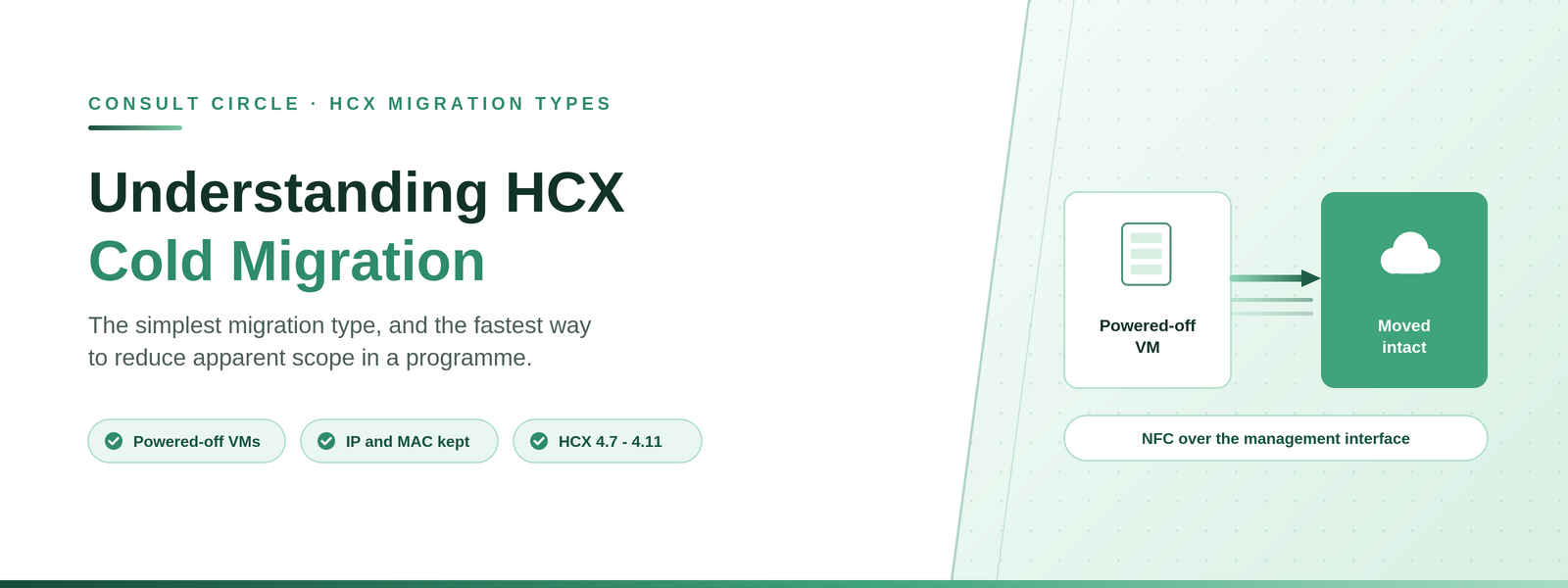
The simplest HCX migration type, what it preserves, and why it is the fastest way to reduce apparent scope in a migration programme.
HCX Cold Migration transfers a powered-off virtual machine using the same network path as HCX vMotion. Because the machine is not running, there is no memory or execution state to capture - but the IP address and MAC address are still preserved.
It is the least glamorous migration type and one of the most useful. Every estate contains templates, dormant systems and decommissioned-but-not-deleted machines. Clearing them early with Cold Migration reduces the apparent size of the remaining programme and exercises the Service Mesh with no risk.
Selected automatically: if a virtual machine is powered off when you submit it for migration, HCX sets Cold Migration by default. Applies to HCX 4.7 - 4.11; validate specifics against the VCF 9.0 documentation if you are on a later release.
Shrink the programme first
Clearing dormant workloads de-risks wave one
We sweep the estate for templates and powered-off machines and move them before the real waves begin.
Book a free 30-minute callRequirements and Limitations
Cold migrations must satisfy the same requirements as HCX vMotion.
- HCX Interconnect tunnels must be up and active.
- The same 150 Mbps or higher throughput capability applies to the underlay.
- Virtual machine hardware version must be 9 or higher.
- The underlying architecture must be x86.
- Virtual machines with RDM in virtual compatibility mode can only be migrated using Bulk Migration.
- The migration service must be activated in both Compute Profiles and in the Service Mesh.
- Port groups that are VLAN trunks do not appear in the migration interface.
NFC is the primary protocol here. VMware NFC is the primary protocol during Cold Migration, and the secondary protocol during HCX vMotion. HCX always routes Cold and vMotion NFC traffic through its Management interface, even where ESXi hosts use a dedicated Provisioning VMkernel for NFC. If your firewall policy assumes NFC follows the vMotion network profile, Cold Migration will fail in a way that looks like a connectivity problem. The flows are set out in our HCX port requirements guide.
Restrictions
The vMotion restrictions apply, since Cold Migration uses the same path and requirements.
- Shared SCSI bus, multi-writer flag, Fault Tolerance, or shared VMDK disk sharing.
- Attached virtual media or ISO images.
- Hardware version 8 or earlier.
- VMware software appliances, including vCenter Server and NSX Manager.
- vSphere VM Encryption is not supported with HCX migrations.
- Attached serial port devices. Detach first, or use Bulk Migration.
- Virtualization Based Security (VBS) is not supported with HCX migrations.
Procedure
Migrations are always configured from the HCX system that initiated the site pairing. In cloud-to-cloud deployments with bi-directional pairing, migrations can be initiated from either site.
- In the HCX interface, go to Services and then Migration.
- Select Migrate Virtual Machines.
- Choose the Remote Site Connection for the destination.
- From the Migration Profile, select Cold Migration.
- Select the virtual machines from the inventory list.
- Set the Transfer and Placement, Switchover, Interconnect Service Mesh and Extended options.
- Map the destination network for each virtual machine and confirm.
- Run Validation.
- Click Go, then monitor progress from the same Migration view.
Progress moves through Initiated, Transfer, Switchover and Migration Complete. The full programme sequence is covered in our step-by-step HCX walkthrough.
Things to Watch Out For
- The machine must stay powered off. Anything that powers a virtual machine back on mid-transfer - an automation job, a scheduled task, a well-meaning colleague - will disrupt the migration.
- Full outage for the duration. Unlike Bulk Migration, there is no online replication phase. The transfer time is the outage. For a large powered-off machine on a constrained link, that can be substantial.
- Use it deliberately to shrink the programme. Sweeping the estate for powered-off machines and templates early gives a genuine reduction in remaining scope and a low-risk rehearsal of the Service Mesh.
- Do not confuse it with an archive. Cold Migration moves the machine. If a powered-off virtual machine is genuinely no longer needed, retire it rather than paying to move and store it.
If a cold migration fails on what looks like connectivity, start with our HCX migration problems guide and which log to read before opening a case.
Frequently Asked Questions
What is HCX Cold Migration?
The migration of a powered-off virtual machine between HCX sites, using the same network path as HCX vMotion. The IP address and MAC address are preserved.
Does Cold Migration preserve the MAC address?
Yes. Both the IP address and the MAC address are preserved during a cold migration.
When should I use Cold Migration instead of Bulk Migration?
When the virtual machine is already powered off and there is no benefit to online replication. For a powered-on machine that can tolerate a reboot, Bulk Migration is usually better because the source stays online during transfer.
Can I schedule a Cold Migration?
Scheduling through the Switchover settings is available for Bulk, RAV and OSAM migrations. Cold Migration and vMotion do not offer it.
Why is my Cold Migration failing on a firewall?
Cold Migration uses VMware NFC as its primary protocol, and HCX routes that traffic through its Management interface rather than the vMotion network profile. Firewall rules written against the vMotion network will not cover it.
Talk to Consult Circle
Clearing the dormant portion of an estate early is one of the cheapest ways to de-risk a migration, and we build it into wave one of every VCF migration.
Consult Circle
Book a free 30-minute call
0203 916 5593 · info@consultcircle.com
Talk to a migration consultant