Consult Circle · AI & Automation
AI Automation Services
We find the processes worth automating, build them, and make sure they are still running a year later.
- Free discovery call
- Fixed-fee assessment
- UK data sovereignty
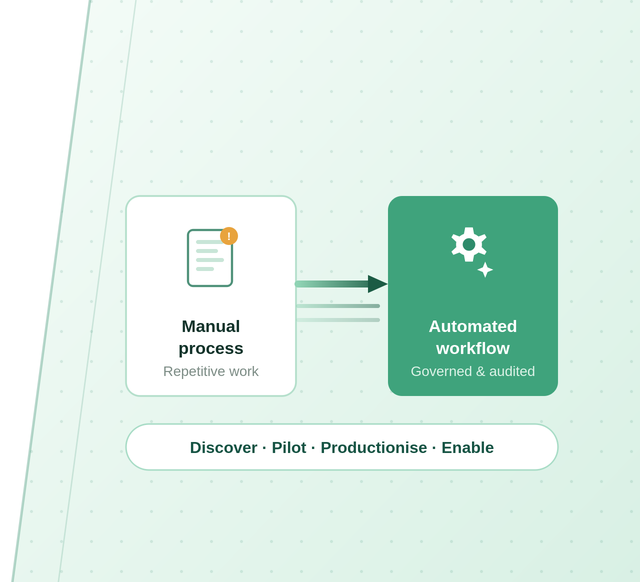
Most businesses do not have an AI problem. They have a process problem that AI happens to be good at solving - an inbox nobody can keep up with, invoices retyped from PDFs into a finance system, reports rebuilt by hand every month, and a support queue where half the questions have the same answer.
Consult Circle finds the processes where automation genuinely pays back, builds them, and puts the security, governance and training in place so they are still running a year later. We work with UK organisations across private and public sector, and we are a Crown Commercial Government Supplier.
Start with the honest version
Book a free 30-minute discovery call. We will look at two or three candidate processes and tell you which ones are worth automating - including the ones that are not. 0203 916 5593.
What we automate
These are the processes that come up again and again, and where the return is easiest to evidence.
| Process | What automation does | Where the return comes from |
|---|---|---|
| Shared inbox and enquiry handling | Classifies incoming email, extracts the key details, routes to the right team, drafts a first response for a human to approve | Removes triage time, cuts response times, makes a hidden mailbox process visible and measurable |
| Invoice and document processing | Reads PDFs and scans, extracts fields, validates against your records, writes into the finance or line-of-business system | Eliminates rekeying and the error rate that comes with it |
| Quotes, proposals and contract review | Drafts from approved templates using your own content, flags non-standard clauses for review | Shortens turnaround and keeps output consistent with what legal has already approved |
| Reporting and reconciliation | Pulls from multiple systems, produces the recurring pack, highlights exceptions rather than restating everything | Recovers the days lost to month-end assembly work |
| Support and service desk triage | Classifies tickets, suggests resolutions from your knowledge base, auto-resolves the routine, escalates the rest | Deflects repeat questions and gets harder tickets to the right person faster |
| Onboarding and internal requests | Turns a form or email into the full sequence of account creation, approvals, access and notifications | Removes the coordination overhead and the steps people forget |
| Knowledge and document search | A grounded assistant that answers from your own documents and cites where the answer came from | Stops the search for information that already exists somewhere |
Our AI automation services
Discovery and use case prioritisation
We map the processes you actually run, score candidates on value, effort and risk, and give you a ranked backlog rather than a list of possibilities. The output tells you what to do first, what to leave alone, and what needs fixing before automation is realistic.
Deliverables: process map · scored use case backlog · indicative effort and cost per use case · recommended starting point
Workflow and process automation
Building the automations themselves - document processing, email handling, approvals, data movement between systems, and the exception paths that decide whether an automation survives contact with real work. We build on the platforms you already own where possible.
Deliverables: working automations · exception handling · monitoring and alerting · documentation and runbooks
AI agents and assistants
Assistants that do more than answer questions: they look up records, raise requests and trigger workflows. Scoped to what they genuinely know, grounded in your own content, and built to hand over to a person rather than guess when they reach the edge of their knowledge.
Deliverables: deployed assistant · grounding and scope configuration · escalation paths · usage reporting
Microsoft 365 and Copilot adoption
Licensing review, data hygiene and the permissions clean-up that has to happen before Copilot is safe to switch on. Then a pilot group, measured adoption and a rollout that does not stall after the first month.
Deliverables: readiness assessment · permissions remediation plan · pilot and rollout plan · adoption measurement
The step most rollouts skip
Copilot surfaces whatever a user already has permission to see. In most tenancies that is considerably more than anyone intended, because SharePoint permissions have accumulated for years. Auditing and fixing that before rollout is not optional, and finding it afterwards is a security incident rather than a project task. Pair this with Microsoft 365 migration if your data is not yet in the right place.
Private and sovereign AI
Where data cannot leave your control - regulated sectors, public sector, sensitive commercial information - we build retrieval-augmented generation and private model deployments that run inside your own tenancy or on your own infrastructure. Your documents stay where they are; the model comes to the data rather than the reverse.
Deliverables: private deployment · retrieval pipeline over your content · access controls aligned to existing permissions · audit logging
Running privately on your own platform? See VCF Design and Monitoring as a Service.
AI governance and compliance
Acceptable use policy, data classification, human-in-the-loop controls, audit trails and the documentation you will need when someone asks how a decision was reached. Relevant whether we built the automation or you did.
Deliverables: acceptable use policy · data classification and handling rules · control design · audit and logging approach
Training and enablement
Practical sessions for the people who will use the tools daily, and separate sessions for leadership on where the risks and the realistic returns actually sit. Automation that nobody understands gets worked around within a quarter.
Deliverables: user sessions · leadership briefing · runbooks and handover · adoption review
The platforms we build on
We are not tied to a single vendor. The right platform depends on what you already own, where your data has to live, and how much control you need.
| Platform | Best suited to | Considerations |
|---|---|---|
| Microsoft Power Platform - Power Automate, AI Builder, Copilot Studio | Organisations already invested in Microsoft 365, with data in SharePoint, Dataverse or Outlook | Fast to build and well governed. Licensing and capacity need modelling properly before you scale |
| Microsoft 365 Copilot | Broad productivity gains across an existing Microsoft estate | Requires licensing and, critically, permissions hygiene before rollout |
| Azure AI services | Custom solutions needing more control than the low-code platforms allow | More capable and more work. Data residency is configurable and should be configured deliberately |
| Open and self-hosted models | Sensitive data, sovereignty requirements, or high-volume workloads where per-call pricing does not scale | Runs on infrastructure you control. Needs capacity planning and ongoing maintenance |
| Integration with existing line-of-business systems | Anywhere the value depends on writing results back into the system of record | Usually the part that determines whether an automation is genuinely useful or just a demo |
Why Consult Circle
Most AI automation providers come from one of two directions: application specialists who build workflows, or infrastructure specialists who do not do AI. The work usually needs both.
We build the automation and the platform underneath it
Consult Circle delivers VMware Cloud Foundation design, migration and disaster recovery alongside AI work. When a solution needs to run on infrastructure you control, we are not handing that half of the problem to someone else.
Sovereignty is a design option, not an obstacle
If your data cannot go to a public model endpoint, we have somewhere else to put it. That is a genuine constraint for a great many UK organisations and it rules out a lot of providers.
Crown Commercial Government Supplier
We are set up to work with UK public sector organisations through established procurement routes.
We will tell you when not to automate
A process that changes every month, or one that runs four times a year, is rarely worth automating. Saying so early is cheaper for both of us than discovering it at the end of a build.
Infrastructure work sits alongside this: VCF Design, Disaster Recovery Services and BC/DR Planning.
How we work
Discover
1-3 weeks
Workshops to understand the processes, the data, the systems and the constraints. Candidate use cases scored and ranked.
Pilot
2-4 weeks
One narrow use case, time-boxed, with success measures agreed before we start. Proves value or disproves it quickly.
Productionise
3-6 weeks
Integrate properly, secure it, monitor it, document it. Exception handling built for how the process actually behaves.
Enable
1-2 weeks
Train the users, hand over runbooks, measure adoption, agree the support model.
Durations are indicative for a single use case of moderate complexity. Multiple use cases run in parallel once the first has been through the full cycle and the patterns are established.
Engagement options
| Package | What it covers | Commercial shape |
|---|---|---|
| AI Discovery Call | A 30-minute conversation about two or three candidate processes, with an honest view on which are worth pursuing | Free |
| AI Readiness and Use Case Assessment | Process mapping, scored use case backlog, data and licensing review, costed roadmap | Fixed fee |
| Pilot Build | One use case built, tested and measured against agreed success criteria | Fixed fee |
| Automation Delivery | Ongoing build across a prioritised backlog | Per use case or time and materials with an agreed cadence |
| Governance and Assurance | Policy, controls, audit approach and review of automations already in use | Fixed fee |
| Support and Optimisation | Monitoring, maintenance, and iteration as processes change | Monthly |
Which of your processes is costing the most time?
Tell us, and we will come back with two or three realistic automation candidates, an indicative cost, and a straight answer on which one to start with.
Governance, data protection and risk
Automation that handles personal or commercially sensitive data brings obligations that do not disappear because a model is involved.
UK GDPR and the Data Protection Act
Lawful basis, data minimisation and retention apply to automated processing as much as to anything else. Where processing has a significant effect on individuals, meaningful human involvement matters.
Data residency
Know where your data is processed and where the model runs. For some organisations any processing outside the UK is a non-starter, and that constraint should shape the design from day one.
Human in the loop
We default to designs where a person approves consequential outputs. Full autonomy is a decision to be taken deliberately, on a specific process, with evidence behind it.
Audit trail
What the automation did, what it based the decision on, and who approved it. This is the difference between explaining an outcome and guessing at it.
Wider regulation
Organisations operating in the EU should also consider EU AI Act obligations, which vary by use case and risk classification. We will flag where this is likely to apply.
Frequently asked questions
What are AI automation services?
Services that identify manual, repetitive business processes and automate them using AI and workflow tooling - typically document processing, email and enquiry handling, reporting, approvals and support triage. The work covers finding the right processes, building the automation, and putting governance and training around it.
How much do AI automation services cost?
It depends on the number and complexity of processes. We structure work as a fixed-fee assessment first, then fixed-fee pilots and per-use-case delivery, so cost is known before commitment rather than discovered during it. The initial discovery call is free.
How long does it take to automate a process?
A single moderately complex process typically moves from discovery to production in six to twelve weeks, including a time-boxed pilot. Simple automations are faster; anything touching several systems or requiring integration with a line-of-business platform takes longer.
Do we need Microsoft 365 Copilot licences?
Not necessarily. A great deal can be delivered with Power Platform capabilities such as Power Automate and AI Builder, with Azure AI services, or with self-hosted models. Copilot licensing makes sense for broad productivity gains across an existing Microsoft estate, and we will tell you if it does not apply to what you are trying to do.
Is our data safe if we use AI automation?
That depends entirely on the design. We build so that data stays within your tenancy or your infrastructure wherever the requirement demands it, with access controls aligned to your existing permissions and full audit logging. If data residency or sovereignty is a hard constraint, say so at the outset and it will shape the architecture.
Can AI automation work with our existing systems?
Usually, yes. Integration with the system of record is normally what makes an automation genuinely useful rather than a demonstration. We assess integration options during discovery, including where a system has no usable interface, which does happen and changes the approach.
What is the difference between AI automation and RPA?
Traditional robotic process automation follows fixed rules and breaks when the input varies. AI automation handles variation - reading documents in different formats, interpreting free text, classifying inconsistent inputs. In practice the two are often combined, with AI handling the interpretation and workflow tooling handling the deterministic steps.
Will AI automation replace our staff?
In our experience it removes the parts of a role people least want to do - rekeying, triage, chasing - rather than the role itself. It is worth being straight with teams about this at the start, because automation introduced without that conversation gets quietly resisted.
What if our processes are not documented?
That is the normal starting position. Process mapping is part of discovery, and it frequently delivers value on its own by exposing steps that are duplicated, unnecessary or done differently by different people.
Do you work with public sector organisations?
Yes. Consult Circle is a Crown Commercial Government Supplier, and we are set up to work with UK public sector organisations through established procurement routes.
Can you help if we have already started with AI?
Yes. A common engagement is putting policy, data controls, monitoring and audit around AI tools already in use, so pilots that grew organically can safely go into production.
How do we know if a process is worth automating?
Volume, repetitiveness and stability. A high-volume process that runs the same way every time is a strong candidate. A process that changes shape every month, or runs a handful of times a year, usually is not - and we will say so.
More reading on the technology blog.
Request a free AI discovery call
Tell us the processes you'd like to improve and we'll come back with two or three realistic automation candidates and an indicative cost.
Already started with AI and stuck on governance?
We put policy, data controls, monitoring and audit around AI tools already in use, so pilots that grew organically can safely go into production.